Strategize your products position in customers’ decision narratives.
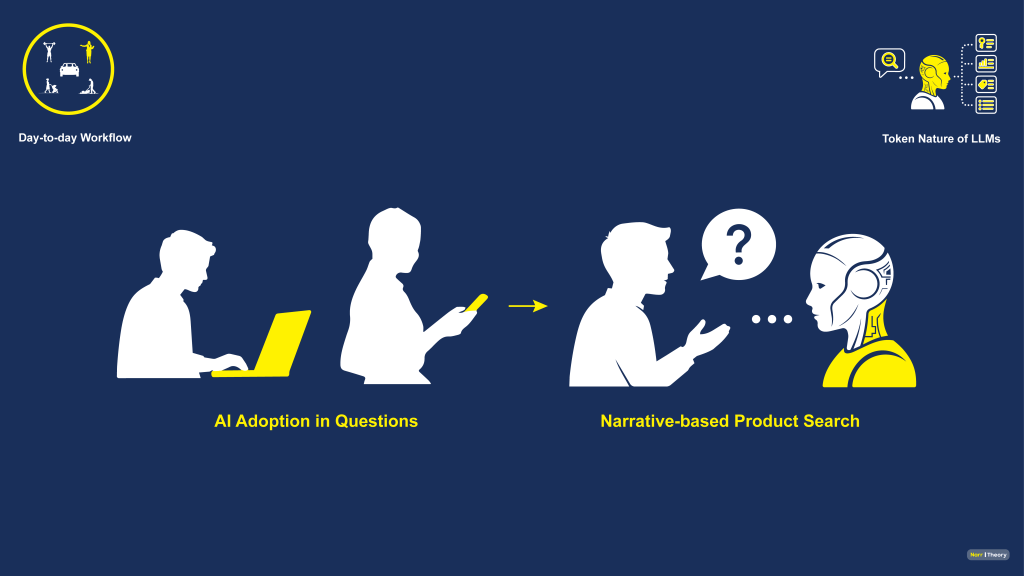
People are increasingly relying on AI to ask questions.
This shifts product search behavior from keywords to narratives.
Instead of reading articles, people converse with AI, ask follow up questions, and narrow their product candidates.
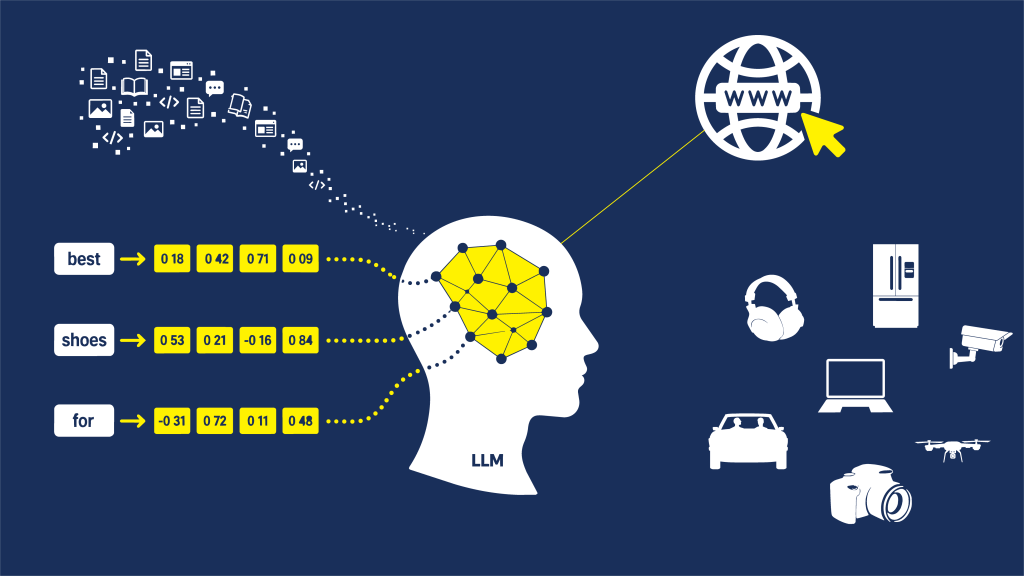
How AI sees, perceives, reason, and position your product is important — it affects global markets speaking that language.
Understand the underlying mechanisms, then set your strategy ahead of competitors.
Why AI Matters for Product Discovery
Millions of people now turn to AI as their first stop for everyday questions. Instead of searching through websites, they ask AI directly for guidance, explanations, recommendations, and solutions.
Whether the question is “How do I remove a coffee stain?”, “What’s the best CRM for a small business?”, or “How should I train for a marathon?”, the interaction begins with a narrative. Every question contains a goal, a problem, and context that AI uses to determine what information is most relevant.
Understanding how people ask AI questions—and how AI interprets those narratives—is becoming fundamental to product discovery, marketing, and customer acquisition.
“I need to buy a new car for my family. We are expecting our second-born child and need more space for baby equipment. I also use this car for day-to-day commute so it should be fuel-efficient. Ideally under $60,000 but I can go up to 70k.”
People no longer search only for information—they increasingly ask AI for recommendations.
Whether choosing software, cameras, running shoes, or appliances, consumers increasingly rely on AI throughout the product discovery and evaluation process.
The next competitive advantage isn’t simply visibility — it’s recommendation.
Narr Theory researches the narratives, evidence, and authority that shape AI recommendation.
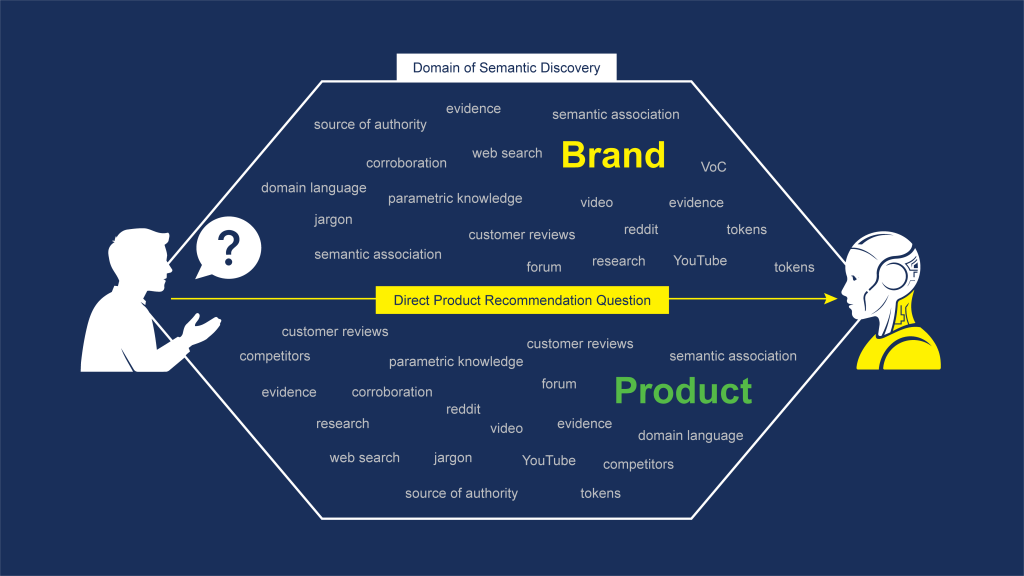
Understand how large language models like ChatGPT, Gemini, or Google AI recommend products based on customer narratives.
Narr Theory hypothesizes that the behavioral adoption of asking questions directly to AI is reshaping product discovery, evaluation, and recommendation.
Click on a LLM below to see how it recommends products.
ChatGPT normalized asking AI questions as a mass-market behavior, making question-based interaction one of the defining behaviors of the AI era.
While Google still dominates most of the search volume combined with Maps, Voice, address bar search, Image, and Shopping, ChatGPT has become the platform people most readily associate with asking AI for guidance, explanations, and help making decisions.
ChatGPT’s mass-market adoption makes it one of the most important AI ecosystems for understanding how people ask questions, evaluate options, and discover products.
Understand how ChatGPT interprets user narratives and recommends products.
Claim your top position and defend your territory.
Narr Theory hypothesizes that the behavioral adoption of asking questions directly to AI is reshaping product discovery, evaluation, and recommendation.
ChatGPT normalized asking AI questions as a mass-market behavior, making question-based interaction one of the defining behaviors of the AI era.
While Google still dominates most of the search volume combined with Maps, Voice, address bar search, Image, and Shopping, ChatGPT has become the platform people most readily associate with asking AI for guidance, explanations, and help making decisions.
ChatGPT’s mass-market adoption makes it one of the most important AI ecosystems for understanding how people ask questions, evaluate options, and discover products.
Understand how ChatGPT interprets user narratives and recommends products.
Claim your top position and defend your territory.
How users define their needs and criteria for a product
Source of Authority
The sources AI relies on to validate a product claim.
Corroboration
AI confidence grows when multiple credible sources independently support the same product claim.
Parametric Knowledge
Associations encoded in model parameters shape which products AI already considers relevant and credible.
Ideal Product Category for AIPR
AIPR matters most where buyers research, compare, and rely on evidence before choosing.
How to set an AIPR Strategy
Track where your product appears across the Discovery Chain, understand why, and turn the evidence into action.
PARSE Tech Stack
Tools that will help companies track how their products are perceived by AI relative to target decision narratives.
Epistemic Root of AI-Perceived Product Claim
Trace the claims, evidence, and sources that lead AI to perceive a product claim as true.
About Narr Theory
Narr Theory is an independent research initiative focused on understanding how large language models recommend products.
As AI becomes a primary way people discover and evaluate solutions, product recommendation is no longer driven solely by search engines, advertisements, or brand awareness. It is increasingly shaped by how AI systems interpret user questions, evaluate evidence, and construct decision narratives.
Narr Theory studies this process—from question formulation and workflow context to source authority, corroboration, and recommendation generation—to help explain why certain products become AI’s top choice.
The goal is to build practical frameworks that help researchers, product teams, marketers, and founders understand how AI recommendation systems evolve and how products can earn a stronger narrative position within them.